
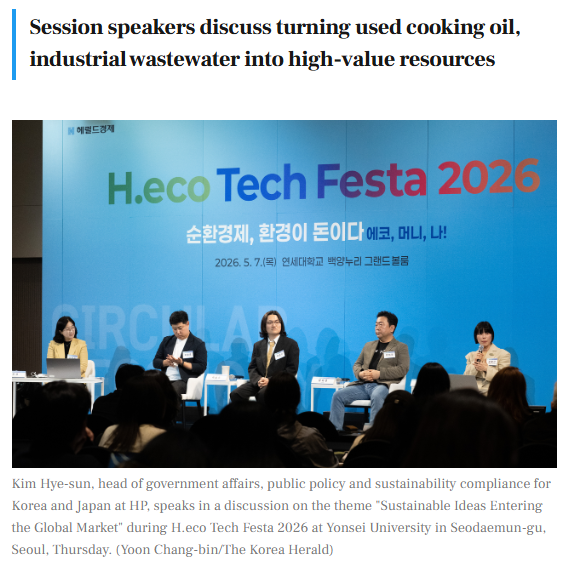
Trash for one person can become a valuable resource for another — and, increasingly, a profitable business model.
That was the message of the first session of H.eco Tech Festa 2026, where entrepreneurs and corporate leaders showed how waste materials ranging from used cooking oil to discarded firefighting suits and industrial wastewater are being turned into high-value resources and global business opportunities.
The session, titled “From Sustainable Ideas to the Global Market,” was held Thursday at Yonsei University's Baekyangnuri Hall as part of Herald Corp.’s eco-tech forum.
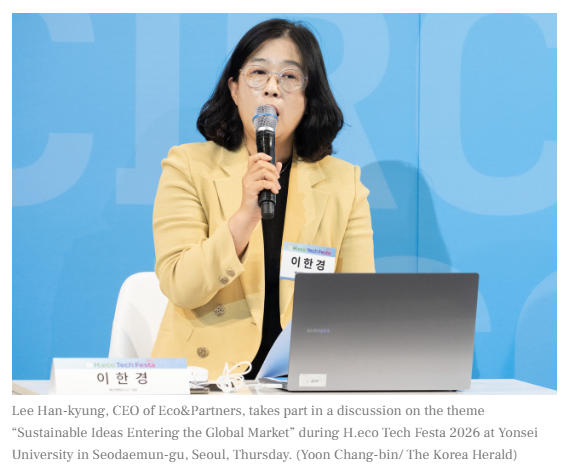
Moderated by Lee Han-kyung, CEO of Eco&Partners, the session saw four businesses that are already proving how environmental solutions can become profitable industries.
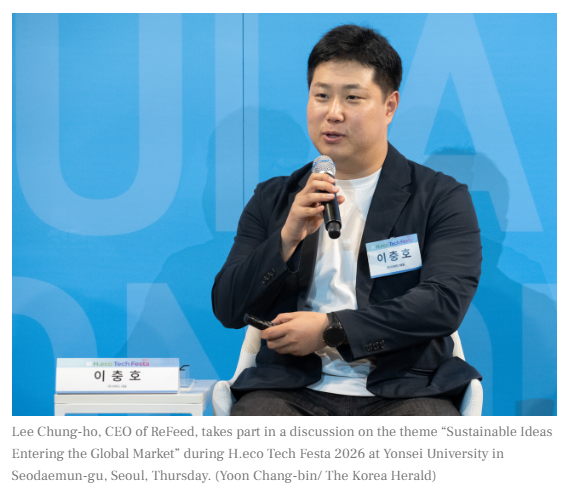
Lee Chung-ho, CEO of ReFeed, introduced a climate-tech business model that collects and digitizes waste cooking oil for use as sustainable aviation fuel.
“By 2050, airlines around the world must achieve net-zero emissions, and sustainable aviation fuel made from used cooking oil is becoming one of the most important solutions,” Lee said.
ReFeed currently operates in South Korea, Vietnam and India, managing waste cooking oil supply chains through digital collection and quality verification systems. The company has also obtained ISCC certification, an international sustainability certification widely used in global biofuel markets.
Lee said the global sustainable aviation fuel market is expected to grow to roughly $157 billion by 2030, adding that transparent data and supply-chain management will become critical competitive advantages.
“What I learned while building the company is that money often comes from doing what others avoid,” he said. “We carried dirty oil containers ourselves, and the data we gathered became our strongest asset.”
He also described how ReFeed expanded into Vietnam early on after identifying weak waste oil management systems there, later combining overseas operations with research and development support from the Korean government.
The company now aims to move beyond collection and enter fuel production itself, with ambitions of becoming what Lee described as “the next Aramco of the energy transition era.”
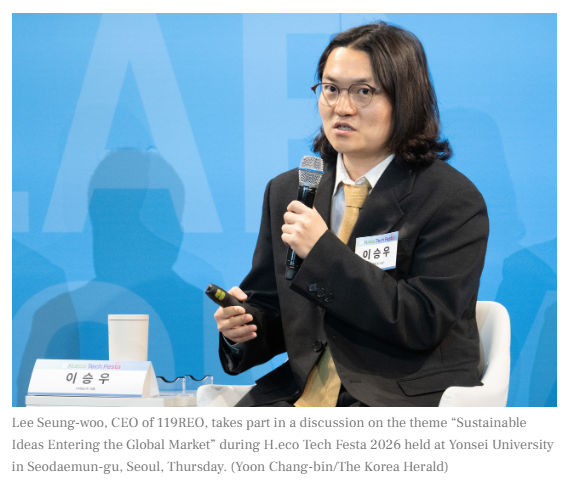
Lee Seung-woo, CEO of 119REO, introduced the company’s upcycling business that transforms used firefighting suits into high-performance industrial and safety materials.
“About 70 tons of firefighter protective suits are discarded every year, but the material is extremely difficult to recycle because it is made from aramid fibers that are five times stronger than steel,” Lee said.
He explained that the company was inspired by the story of late firefighter Kim Beom-seok, who battled cancer after exposure to hazardous substances during firefighting operations.
119REO developed technology to extract aramid fibers from used firefighting suits and reuse them in fire containment devices designed to prevent lithium battery fires on airplanes.
The company currently supplies the products to nine domestic airlines.
“Upcycling in the past appealed mainly to environmental values,” Lee said. “Now, recycled products must outperform conventional products in order to win the market.”
He added that the company is targeting the global aviation safety market, where fire containment devices could eventually be installed under every airplane seat.
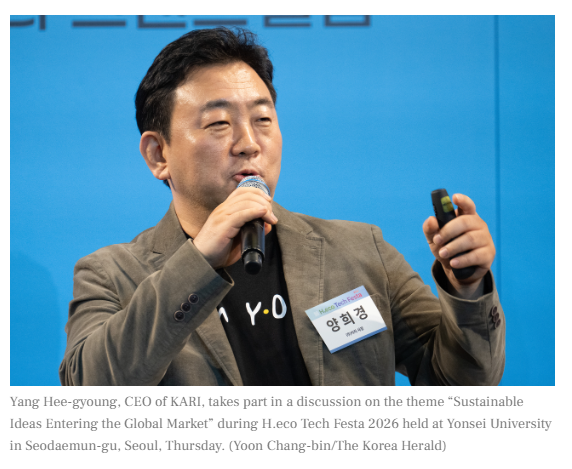
Yang Hee-gyoung, CEO of KARI, presented technology that recovers high-purity resources from industrial wastewater generated during secondary battery manufacturing.
Industrial wastewater from battery production often contains toxic heavy metals and high concentrations of sulfuric compounds, making treatment technically difficult and expensive.
“Instead of simply evaporating wastewater and landfilling the remaining waste, we separate valuable materials at the molecular level through a combination of five integrated technologies,” Yang said.
The recovered materials can then be reused in products such as pharmaceutical ingredients and agricultural fertilizers, forming what Yang described as a new resource circulation value chain.
Yang also shared lessons from building the company as a startup, saying KARI constructed its own factory and accumulated operational data before securing large corporate clients in order to establish credibility in the market.
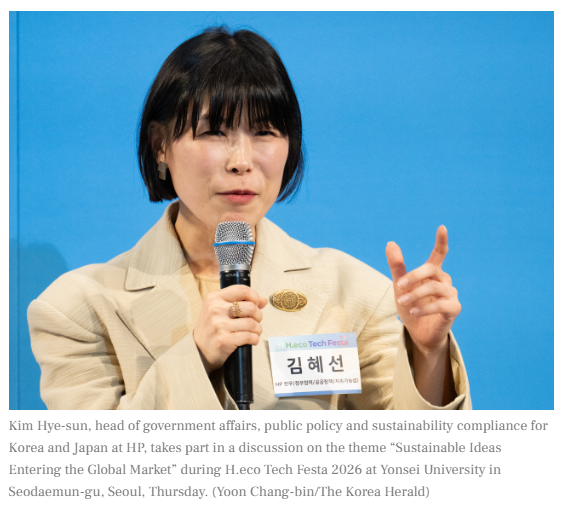
Kim Hye-sun, head of government affairs, public policy and sustainability compliance for Korea and Japan at HP, said sustainability has already become a major source of revenue for global companies.
“More than 60 percent of HP’s approximately 80 trillion won ($54 billion) in revenue in 2024 came from sustainable product lines,” Kim said. “Environment is no longer optional. It has become a business imperative.”
Kim said around 80 percent of environmental impact is determined during the product design stage, leading HP to focus on circular product design that improves repairability and recyclability from the beginning.
She also emphasized the importance of supply-chain management, noting that HP works with approximately 13,000 partners to manage carbon footprints across its value chain.
jychoi@heraldcorp.com
https://www.koreaherald.com/article/10734646